
HE THAT HAS AN EAR

Updated: Feb 6

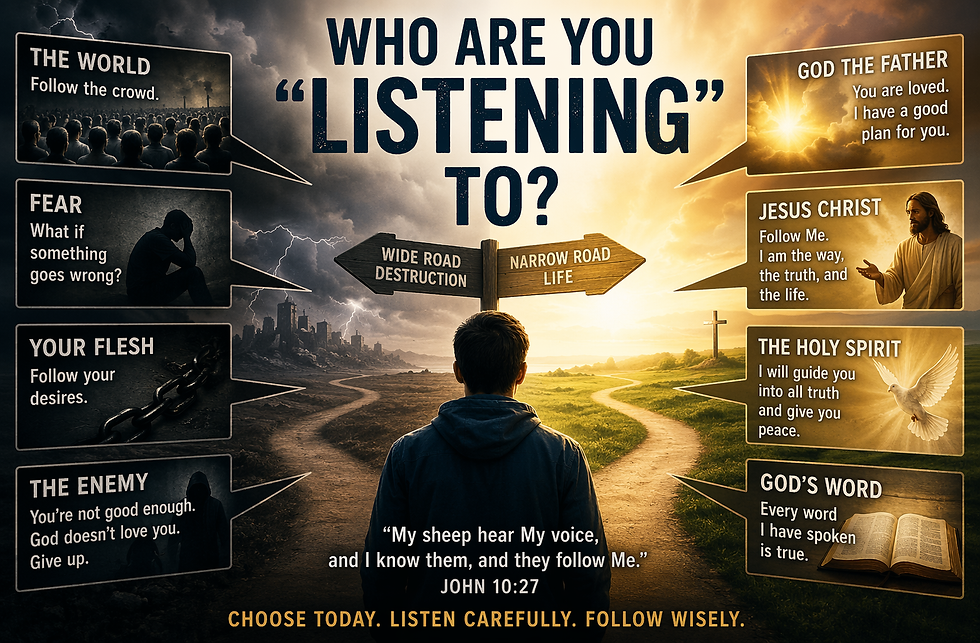
Scripture repeatedly calls us to hear, listen, and understand. These are not casual invitations—they are commands from God to align our hearts, minds, and wills with His truth. The Greek word for “ears,” αυτιά (aftiá), reminds us of the physical organ of hearing. But Jesus’ repeated phrase, “He that hath ears to hear, let him hear,” points beyond biology. It speaks to spiritual attentiveness—an inner posture of humility, receptiveness, and obedience.
The Bible uses:
HEAR – 347 times
LISTEN – 331 times
UNDERSTANDING – 160 times
Clearly, God places enormous weight on what we do with the words He speaks.
More Than Ears: The Difference Between Hearing and Hearing
Matthew 11:15 is straightforward:
“He that hath ears to hear, let him hear.”
Everyone has physical ears, but not everyone has ears that hear. Psalm 135 paints the contrast vividly:
“They have ears, but they hear not…” (vv. 16–17)

The idols of the nations are lifeless—and those who trust in them become just as spiritually unresponsive. The tragedy of Israel in Isaiah 6:9–10 echoes this: they would hear, but not understand; see, but not perceive.
Jesus Himself highlights this "spiritual deafness" in Matthew 13:9–13. Though the crowds heard His words, they did not grasp their meaning. Only those who pursued Him—hungry to understand—received the mysteries of the Kingdom.
Hearing the Word of God is not the same as receiving it.
Ears, Balance, and Spiritual Stability
Physically, the ear is the body’s organ for:
hearing, and
balance (through the vestibular system)
If the ear becomes damaged, our equilibrium falters—we feel dizziness, instability, disorientation.
Spiritually, the same principle holds:
When we do not listen to God, we lose our sense of balance. We lose clarity, direction, and grounding.
We become like those Paul describes in 2 Timothy 4:3–4—drawn toward teachers who satisfy “itching ears,” drifting from truth to fables.
Dispensation and Responsibility
A dispensation is a period in which God deals with humanity in a specific way regarding sin and responsibility. Each dispensation ends in judgment—not because God fails, but because mankind refuses to listen.
Throughout every era, God’s message has been consistent:
Hear My Word.
Obey My Voice.
Walk in My Truth.
Do You Recognize the Bible as God’s Sovereign Word?
The Scriptures are plenary—complete, absolute, fully inspired. As 2 Peter 1:19–21 declares:
“Holy men of God spake as they were moved by the Holy Ghost.”
Because of this, our response must be:
ADMIT – affirm its truth.
SUBMIT – obey its commands.
COMMIT – study and memorize it.
TRANSMIT – share it with others.
These reflect the willingness needed for spiritual illumination.
Hebrews 4:12 reminds us why this matters:
“The word of God is quick, and powerful… a discerner of the thoughts and intents of the heart.”
To truly hear the Word is to be transformed by it.
The Blessing of Spiritually Open Ears
Jesus told His disciples in Matthew 13:16:
“Blessed are your eyes, for they see: and your ears, for they hear.”
Hearing spiritually is a blessing—one that prophets longed for (v. 17). Many physically heard the words of Christ, but only a few understood. The difference was not intelligence—it was openness.
He That Hath an Ear: The Overcomer’s Call
The Promise of the Tree of Life
Revelation 2:7
“…To him that overcometh will I give to eat of the tree of life, which is in the midst of the paradise of God.”
The first reward is nothing less than restored access to the Tree of Life—lost in Eden, guarded since Genesis, and kept by God for the redeemed.
To “overcome” here means to remain faithful in a world that pressures believers to compromise.
The reward is eternal nourishment, eternal fellowship, and eternal life in the presence of God.
The Promise of Protection from the Second Death
Revelation 2:11
“He that overcometh shall not be hurt of the second death.”
The “second death” is explained later in Revelation 20:14 as the final judgment—the lake of fire.
The overcomer is not just spared punishment; he is shielded from it entirely.
In a world full of fear—fear of death, fear of judgment, fear of uncertainty—Christ speaks a greater word:
Faithfulness secures eternal safety.
Overcomers need not fear the grave or what lies beyond it.
The Hidden Manna and the White Stone
Revelation 2:17
“…To him that overcometh will I give to eat of the hidden manna…”
Hidden manna represents divine provision—bread from heaven that only GOD can supply. In a spiritually starved world, GOD promises nourishment unseen by the world but revealed to the faithful.
And then comes the mystery:
“…and will give him a white stone, and in the stone a new name written…”
Throughout ancient culture, a white stone symbolized:
acquittal in court
admission to special events
victory in athletic contests
But Christ’s stone carries something deeper—a new name, known only to the receiver.
This is personal.
Intimate.
A symbol of identity transformed by GOD Himself.
To overcome is not simply to survive; it is to become someone eternally marked by God’s grace.
Free Will and the Choice to Hear
God does not force us to listen. Scripture teaches that each of us chooses whether to receive or reject His Word.
Revelation repeats the phrase:
“He that hath an ear, let him hear what the Spirit saith unto the churches.”
The Spirit speaks.
But will we listen?
The Warning in Revelation 13:9
Revelation 13:9
“If any man have an ear, let him hear.”
The tone shifts here.
Now the words come in the context of global deception and spiritual darkness during the rise of the beast.
The invitation is no longer just encouraging—it is urgent.
As deception increases, the ability to hear truth becomes the difference between life and destruction.
The Scriptures Must Be Impressed Upon the Heart
In every generation—from the prophets (Hebrews 1:1–2) to the early church (Hebrews 2:1–4)—God has spoken with clarity and power. Yet the danger remains:
“…lest at any time we should let them slip.” (Hebrews 2:1)
Spiritual hearing requires attention, humility, and wholehearted seeking. As God promised in Jeremiah 29:13:
“You shall seek me, and find me, when you shall search for me with all your heart.”
Illumination Requires the Holy Spirit
Sin blinds. Carnality dulls spiritual hearing. Only the Holy Spirit can reveal the deep things of God.
1 Corinthians 2:10–14 teaches that:
The natural man cannot receive spiritual truth.
The Holy Ghost teaches the things of God.
Spiritual understanding is a gift, not a human achievement.
We must ask:
Do I have the willingness to be guided by the Holy Ghost?
The Final Call to Hear
Revelation 2:29
“He that hath an ear, let him hear what the Spirit saith unto the churches.”
Christ repeats the command again—because hearing is not automatic.
Spiritual hearing requires humility, repentance, and openness to the Spirit’s voice.
This repetition is not for emphasis alone—it is mercy.
A second chance.
A renewed invitation.
Faith Comes by Hearing (Romans 10:13–18)
Salvation is impossible without hearing the WORD:
“Faith cometh by hearing, and hearing by the word of God.” (v. 17)
To hear is to open the door to belief, obedience, and transformation.
Conclusion: Do You Have Ears to Hear?
The question Jesus asked still echoes today:
Are your ears open?
Not merely the physical ears, but the ears of the heart.
The call of Scripture is clear:
Hear God’s Word.
Understand God’s truth.
Obey God’s voice.
Be led by God’s Spirit.
The Spirit speaks—not in riddles, not in obscurity, but through the living Word of God.
He that has an "ear", let him "hear".
Do you desire prayer?
Do you desire salvation?
If you want to know Christ—and be known by Him—today is the day.
“Now is the accepted time; behold, now is the day of salvation.” - 2 Corinthians 6:2
I can help you with a prayer, Scripture guidance, or steps to salvation—just let me know how you’d like to continue.
“3 Jesus answered and said unto him, Verily, verily, I say unto thee, Except a man be born again, he cannot see the kingdom of God. 4 Nicodemus saith unto him, How can a man be born when he is old? can he enter the second time into his mother's womb, and be born? 5 Jesus answered, Verily, verily, I say unto thee, Except a man be born of water and of the Spirit, he cannot enter into the kingdom of God.” - John 3: 3-5


"Glory to Jesus!!" Yes indeed!!
HALLELUJAH!!! GLORY TO JESUS!!!
Thank you for responding and comment.
Your reflection goes right to the heart of the gospel. The very fact that we can hear God at all is not something we can trace back to our own ability, clarity, or spiritual insight—it’s an act of God’s initiating love.
Scripture makes this unmistakably clear. Human beings are not merely "unwilling" to hear; we are "unable" apart from God’s intervention. So when you ask whether closed ears can simply be commanded to listen, the biblical answer leans heavily toward grace: there must first be an "opening", a divine act that makes hearing possible.
This is where "1 John 4" gives profound clarity. John writes,…
Glory to Jesus!!
I understand that we are called to hear—but the question that keeps returning is this: why have I become someone who can hear at all? Was I always able to hear, or was my hearing opened by someone else? If a person is truly unable to hear, can we still hold them fully responsible for not hearing? Scripture itself tells us that human beings are spiritually unable to hear.
So if someone’s ears are closed, is it enough to say, “Why aren’t you listening,” or must there first be an act of grace that opens those ears?
This is why the question naturally leads to the cross. In Scripture, the cross is the moment that exposes th…