
WHO ARE YOU "LISTENING " TO?


Why the Voice of God Must Be the Highest Authority in Our Lives
In every season of life, many voices compete for our attention. Some voices are external—family, culture, media, leaders, and peers. Some voices are internal—our emotions, memories, fears, desires, and reasoning. Other voices are spiritual—either the voice of God leading us into truth, or the voice of the enemy attempting to deceive, accuse, and distract. The real question is not simply what voices are speaking, but which voice has the greatest authority in our decisions.
The loudest voice in a person’s life is not always the one that is most audible, emotional, dramatic, or popular. The loudest voice is often the one that is most believed, most obeyed, and most followed. Scripture teaches that for the believer, the voice that must become the “loudest” is the voice of God—revealed through His Word, confirmed by His Spirit, and made known in a life of prayer, obedience, and discernment.
Foundational Scriptures
Proverbs 14:2–12 (KJV)
This passage contrasts the upright and the foolish, the wise and the scorner, the righteous and the wicked. It shows that human judgment can be dangerously flawed:
“There is a way which seemeth right unto a man, but the end thereof are the ways of death.”(Proverbs 14:12, KJV)
This verse is central to understanding the subject of competing voices. A voice can seem reasonable, convincing, logical, or emotionally satisfying, and still be wrong. If people are not governed by God’s truth, they can easily mistake error for wisdom and deception for direction.
Isaiah 30:27–32 (KJV)
Isaiah presents the majesty and terror of the Lord’s power and emphasizes the irresistible authority of His voice:
“And the Lord shall cause his glorious voice to be heard…”(Isaiah 30:30, KJV)
In this text, the voice of the Lord is not passive or weak. It is glorious, authoritative, and effective. It judges, shakes, overthrows, and establishes. The voice of God is not merely information—it is divine power in operation.
Romans 1:16–21 (KJV)
Paul reminds us that God has made Himself known. Yet humanity often rejects His truth, suppresses righteousness, and follows vain imaginations:
“Because that, when they knew God, they glorified him not as God… but became vain in their imaginations, and their foolish heart was darkened.”(Romans 1:21, KJV)
This passage reveals the danger of listening to the wrong voice. When men reject divine truth, they are not left neutral—they become darkened in understanding. Wrong voices do not simply mislead; they corrupt perception and harden the heart.
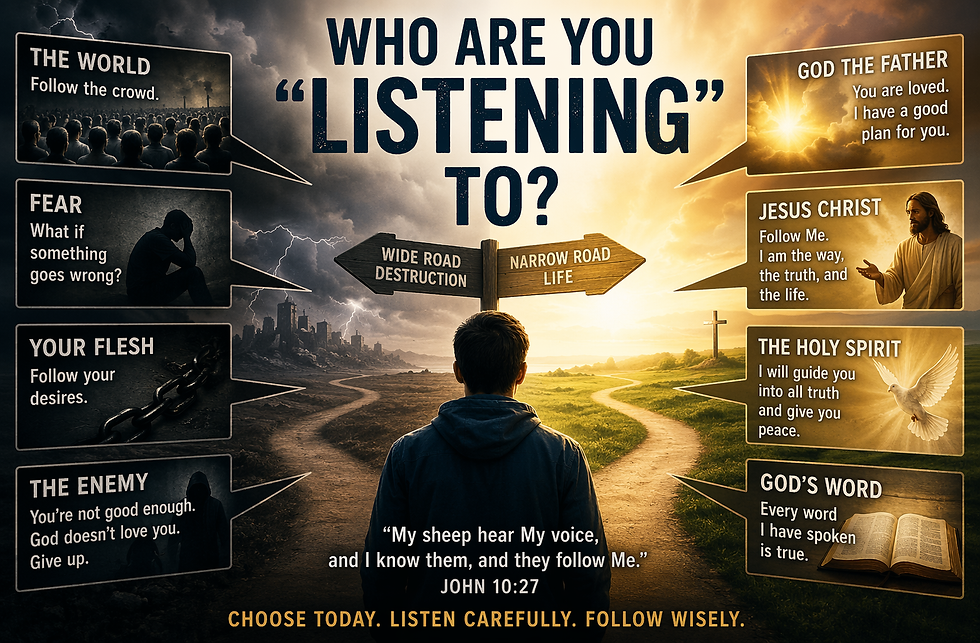
Understanding the Different Voices
1. The Voice of God
The voice of God is the truest and highest voice. It is always righteous, holy, life-giving, and authoritative.
The Father
The Father’s voice is sometimes expressed in direct and overwhelming manifestations of divine presence. At significant moments in the life of Christ, the Father declared His approval audibly, revealing heaven’s authority.
The Son
Jesus Christ speaks through His earthly teaching and continues to speak through His Word. His voice defines discipleship:
“My sheep hear my voice, and I know them, and they follow me.”(John 10:27, KJV)
The Holy Spirit
The Holy Spirit convicts, comforts, leads, teaches, and guides believers into truth. The Spirit never speaks contrary to Christ or Scripture, but magnifies Jesus and directs the believer into obedience.
2. The Voice of Mankind
Human voices can be helpful or harmful depending on whether they align with God.
Prophetic Voices
God often uses men and women filled with His Spirit to speak warnings, encouragement, correction, and revelation. These voices are not independent authority; they must always align with God’s Word.
The Voice of the People
The crowd can be persuasive but wrong. Public opinion is often loud, emotional, and forceful. Scripture repeatedly shows that majority opinion is not always moral truth.
The Flesh
The flesh is the natural human tendency toward self-will, sin, pride, and worldly desire. It often speaks in the language of appetite, impulse, convenience, and self-justification.
The Wise and Faithful
God also provides wise voices—apostles, biblical writers, elders, mentors, and faithful witnesses—who speak truth, instruction, and godly counsel.
3. The Voice of the Enemy
The enemy’s voice is deceptive by nature. Satan does not merely oppose truth—he counterfeits it, twists it, and weaponizes it.
Satan
The devil tempts, lies, accuses, and seeks to draw people away from God’s will. In Eden, he questioned God’s Word. In the wilderness, he twisted Scripture against Jesus.
Demonic Influence
Scripture acknowledges spiritual forces of darkness that resist God’s kingdom, oppose truth, and seek to enslave people through fear, deception, and rebellion.

Types of Voices We Encounter
To understand influence, Scripture helps us recognize the various kinds of voices operating around and within us.
A. External Voices (Outside of You)
Authority voices – leaders, laws, supervisors, parents
Instructional voices – teachers, coaches, mentors
Informational voices – media, news, social platforms
Relational voices – family, friends, close associations
Cultural voices – trends, social norms, popular ideologies
B. Internal Voices (Within You)
Conscience voice – moral awareness that affirms or convicts
Reason voice – logic, analysis, deliberation
Emotion voice – fear, anger, joy, grief, shame
Memory voice – past pain, trauma, victories, learned patterns
Desire voice – cravings, ambitions, longings
C. Competing Voices (Conflict and Pressure)
Temptation voice – compromise, shortcuts, sinful suggestions
Accusation voice – condemnation, shame, despair
Confusion voice – instability, overload, mixed signals
Truth voice – righteousness, clarity, peace, holiness
Not every voice deserves equal weight. Not every impression deserves obedience. Not everything pressing you is leading you.
The Voice of the Lord: What It Does
The Bible reveals that the voice of the Lord is not passive. It accomplishes divine purposes.
A. It Creates and Sustains
Creation itself began with divine speech:“ And God said…”God’s voice is creative power. He speaks, and reality responds.
Genesis 1
Psalm 33:6, 9
B. It Reveals God’s Holiness and Glory
The voice of the Lord often accompanies divine manifestation. Sinai thundered with His presence. Psalm 29 repeatedly emphasizes the overwhelming power of His voice.
Exodus 19–20
Psalm 29
C. It Commands Covenant Obedience
God’s voice establishes His will. He does not merely advise—He commands.
Exodus 20:1
Deuteronomy 6:4–5
D. It Calls and Commissions
God’s voice summons people to purpose and service.
1 Samuel 3:1–10
Isaiah 6:8
E. It Warns, Judges, and Shakes What Is False
The voice of God exposes what is unstable, deceptive, or rebellious.
Psalm 29:3–9
Hebrews 12:25–27
F. It Comforts, Guides, and Shepherds
The same God who thunders also leads tenderly.
Isaiah 30:21
John 10:3–4, 27
God’s Voice Is Not Always “Loud”—But It Is Always True
One of the great misconceptions in spiritual life is that the strongest voice is the truest voice. Scripture shows otherwise. God’s guidance is often quiet, but never uncertain.
Elijah did not hear God in the wind, the earthquake, or the fire, but in a still small voice (1 Kings 19:11–13). This teaches us that divine authority does not depend on dramatic presentation. God’s voice may not compete with the world’s noise in style, but it always surpasses it in truth.
Jesus said:
“My sheep hear my voice… and they follow me.”(John 10:27, KJV)
This means spiritual maturity includes recognition. The believer must learn to distinguish the Shepherd’s voice from all substitutes.
Key Truth:
The loudest voice in your life should not be the most emotional or the most popular voice—it should be the most trustworthy voice: God’s.
The Bible Warns About Other “Loud” Voices
1. The Crowd
Crowds are loud because numbers create pressure. But numbers do not create truth.
Pilate surrendered to the crowd at Jesus’ trial (Mark 15:11–15)
“Thou shalt not follow a multitude to do evil.” (Exodus 23:2)
2. Fear
Fear magnifies danger and minimizes faith. Anxiety can become so loud that it drowns out divine assurance.
“The fear of man bringeth a snare.” (Proverbs 29:25)
“Be anxious for nothing…” (Philippians 4:6–7)
3. The Flesh
The flesh speaks in the language of desire, convenience, and self-gratification.
“The flesh lusteth against the Spirit…” (Galatians 5:17)
“Walk in the Spirit, and ye shall not fulfil the lust of the flesh.” (Galatians 5:16)
4. The Enemy
The enemy speaks through accusation, distortion, and condemnation.
“The accuser of our brethren…” (Revelation 12:10)
Jesus answered Satan with “It is written” (Matthew 4:1–11)
Key Truth:
Some voices are loud because they are forceful, fearful, popular, persuasive, or emotional—but that does not make them true.
God’s Word Must Become the “Loudest” Voice
If there is one voice that must overrule every other voice, it is the Word of God.
Why?
1. God’s Word Guides
“Thy word is a lamp unto my feet, and a light unto my path.”(Psalm 119:105, KJV)
2. God’s Word Discerns
“The word of God… is a discerner of the thoughts and intents of the heart.”(Hebrews 4:12, KJV)
3. God’s Word Renews
“Be not conformed to this world: but be ye transformed by the renewing of your mind…”(Romans 12:2, KJV)
Bottom Line:
The Bible teaches that God’s Word should be the final standard that overrules every other influence.
How to Tell Which Voice Should Lead: Biblical Tests
Scripture gives believers practical tests for discernment.
Test #1: Does It Agree With Scripture?
“To the law and to the testimony…” (Isaiah 8:20)
The Bereans examined teachings by the Scriptures (Acts 17:11)
If a voice contradicts God’s Word, it is not from God—no matter how spiritual it sounds.
Test #2: Does It Produce Godly Fruit or Confusion?
“The wisdom that is from above is… peaceable…” (James 3:17)
“God is not the author of confusion…” (1 Corinthians 14:33)
Truth leads to holiness, clarity, peace, and righteousness. Error leads to confusion, compromise, pride, unrest, and instability.
Test #3: Does It Pull You Toward Christ or Away From Him?
“Set your affection on things above…” (Colossians 3:2)
“Looking unto Jesus…” (Hebrews 12:2)
True guidance glorifies Christ, deepens obedience, and strengthens holiness.
New Testament Emphasis: The Voice of Christ Must Be Supreme
The New Testament makes clear that the voice of Christ must be the highest authority in the believer’s life.
A. Jesus’ Words Are Foundational
“He that rejecteth me… the word that I have spoken, the same shall judge him…” (John 12:48)
“Whosoever heareth these sayings of mine, and doeth them…” (Matthew 7:24)
B. The Holy Spirit Leads in Truth
“As many as are led by the Spirit of God, they are the sons of God.” (Romans 8:14)
“When he, the Spirit of truth, is come, he will guide you into all truth…” (John 16:13)
C. The Peace of Christ Rules the Inner Life
“Let the peace of God rule in your hearts…” (Colossians 3:15)
“The peace of God… shall keep your hearts and minds…” (Philippians 4:6–7)
Teaching Point:
In the New Testament, the loudest voice should be the voice of Christ through His Word and through the Holy Spirit.
The Loudest Voice Is the One You Follow
This is where discernment becomes deeply personal. What rules your life is revealed in what you obey.
Jesus defines discipleship not merely by hearing, but by hearing and following:
“My sheep hear my voice… and they follow me.”(John 10:27, KJV)
Paul adds:
“To whom ye yield yourselves servants to obey, his servants ye are…”(Romans 6:16, KJV)
And again:
“Let the word of Christ dwell in you richly…”(Colossians 3:16, KJV)
Teaching Point:
The loudest voice is not simply the one speaking—it is the one ruling.
Practical Ways to Make God’s Voice the “Loudest” in Your Life
1. Prioritize Prayer
Relationship produces recognition.
“Pray without ceasing.” (1 Thessalonians 5:17)
Prayer tunes the heart toward God and sensitizes the believer to His direction.
2. Meditate on Scripture
What you feed becomes strong.
“This book of the law shall not depart… meditate therein day and night…” (Joshua 1:8)
A neglected Bible produces a noisy soul. A nourished spirit becomes more discerning.
3. Guard Your Heart
Your inner condition affects what you hear clearly.
“Keep thy heart with all diligence…” (Proverbs 4:23)
Inputs matter. Anything continually feeding fear, lust, bitterness, pride, or confusion can distort spiritual hearing.
4. Capture Your Thoughts
Do not let every thought become a commander.
“Bringing into captivity every thought to the obedience of Christ.” (2 Corinthians 10:5)
Not every thought should be trusted. Some thoughts must be rejected, corrected, and submitted to Christ.
5. Obey What God Has Already Said
Obedience increases clarity.
“Be ye doers of the word, and not hearers only…” (James 1:22)
Many people want a new word while ignoring the written Word they already have. God often gives more light to those who walk in the light they have received.
6. Walk in the Spirit
Victory over wrong voices requires spiritual dependence.
“Walk in the Spirit, and ye shall not fulfil the lust of the flesh.” (Galatians 5:16)
7. Stay in Healthy Spiritual Community
Isolation amplifies the wrong voices.
“Exhort one another daily…” (Hebrews 3:13)
God often confirms truth through wise and faithful believers.
Final Conclusion
The issue is not whether voices are present in your life—they are. The issue is which voice carries the most authority in your heart, mind, and actions.
The crowd speaks. Fear speaks. The flesh speaks. Culture speaks. Memory speaks. Desire speaks. The enemy speaks. But above them all, God speaks.
His voice may not always be the most dramatic voice. It may not always be the most emotionally intense voice. It may not always be the most culturally accepted voice. But it is the truest voice, the holiest voice, and the only voice that leads to life.
Proverbs warns us that there is a way that seems right to man but ends in death. Isaiah reveals the glorious and powerful voice of the Lord. Jesus teaches that His sheep hear His voice and follow Him. Therefore, the believer must make a deliberate and daily decision:
to test every voice by Scripture,
to reject voices of deception, fear, and flesh,
to let the Word of Christ dwell richly within,
and to allow the Spirit of God to lead.
Final Charge:
Do not let the loudest cultural voice, the loudest emotional voice, or the loudest fearful voice rule your life. Let the voice of God be the loudest voice—the highest authority, the final standard, and the trusted guide in all things.
Do you desire prayer?
Do you desire salvation?
If you want to know Christ—and be known by Him—today is the day.



Loved this. Such a powerful reminder.
"The real question is not simply what voices are speaking, but which voice has the greatest authority in our decisions.
The loudest voice is often the one that is most believed, most obeyed, and most followed."