
STANDING AT THE CROSSROADS: Choosing the Way That Leads to Life

Updated: Feb 6

Every one of us, at one time or another, finds ourselves standing at a crossroads—a place where two or more paths intersect, and a decision must be made. A crossroads is more than a physical intersection; spiritually, it is a place of priority, position, and purpose. It is the point at which our next steps can shape our destiny.
A crossroads can be defined as:
A crucial point—especially where a decision must be made, and
The place of intersection of two or more roads.
In Greek, the word for crossroads—διασταύρωση (diastávrosi)—speaks to a place where paths meet and diverge. It's a moment of decision, a point of direction, and often, a place of divine invitation.
Scripture is filled with scenes that take place at spiritual crossroads. They remind us that God does not abandon us in these moments but calls us to choose the way that leads to life.
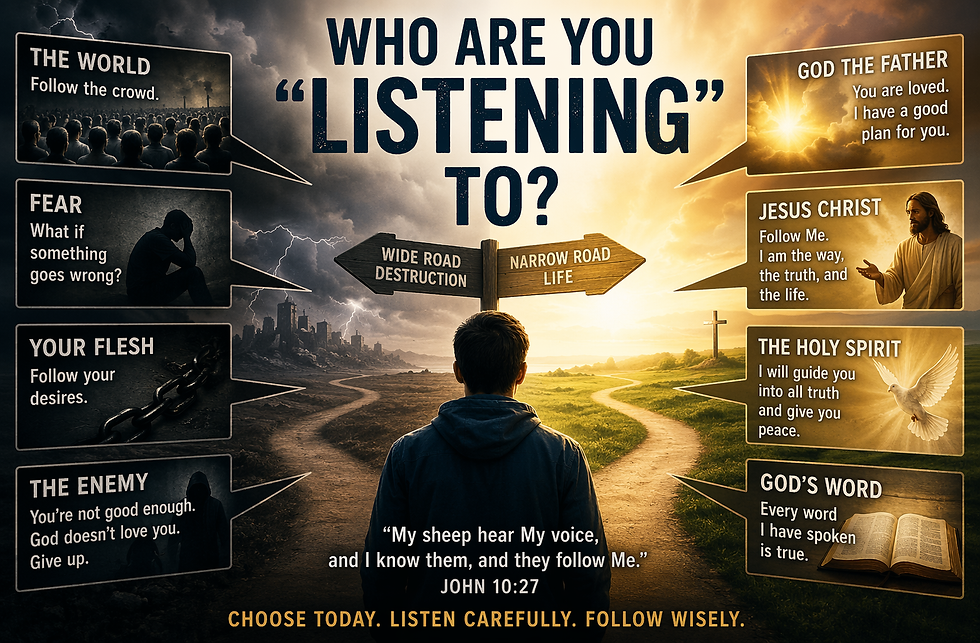
"13 Enter ye in at the strait gate: for wide is the gate, and broad is the way, that leadeth to destruction, and many there be which go in thereat: 14 Because strait is the gate, and narrow is the way, which leadeth unto life, and few there be that find it." - Matthew 7: 13-14
Crossroads in Scripture: The Call to Choose
1. The Crossroads of Allegiance – Exodus 32:25–26
When Moses descended Mount Sinai and found Israel in idolatry, he issued a call that still echoes through time:
“Who is on the Lord’s side? let him come unto me.”— Exodus 32:26 (KJV)
Israel stood at a crossroads of allegiance. Would they follow the God who delivered them—or the idols they had crafted with their own hands?
The sons of Levi responded. Their decision redefined their future.
At a crossroads, what or who we stand with determines where we stand next.
This was a marked crossroads.
The line was visible.
The options were clear.
No one could pretend they didn’t understand the moment.
The sons of Levi positioned themselves on the Lord’s side—and that single decision shaped their tribe’s identity for generations.
Crossroads confront us with the question Moses asked:
Who are you standing with?
2. The Crossroads of Servanthood – Joshua 24:14–15
Near the end of his life, Joshua placed the nation of Israel at another defining crossroads:
*“Choose you this day whom ye will serve… but as for me and my house, we will serve ...
This crossroads was about priority.
Joshua listed their options plainly—foreign gods, ancestral gods, cultural gods—but he made his own decision unmistakable:
“…as for me and my house, we will serve the Lord.”
Crossroads require ownership.
You cannot drift into righteousness.
You cannot inherit devotion.
You must choose God intentionally.

Marked vs. Unmarked Crossroads
Every crossroads—spiritually or naturally—contains two important elements:
Priority (What comes first? What matters most?)
Position (Where am I currently standing? Where will this path lead?)
But the major difference between crossroads lies in whether they are marked or unmarked.
1. Marked Crossroads
A marked crossroads is an intersection where the direction is clear.
Signs are posted.
Warnings are visible.
Guidance is provided.
Natural explanation:
A marked intersection has:
Signs
Traffic lights
Indicators
Clear lanes
Visible boundaries
There is no confusion—you know where each road leads.
Spiritual explanation:
A marked crossroads is a moment when God has made His will clear and unmistakable. You know right from wrong. You know obedience from disobedience. You see the consequences. You recognize the voice of God calling you to choose.
Examples from Scripture:
Joshua 24:15 – “Choose you this day…” (The options were spelled out clearly.)
Exodus 32:26 – “Who is on the Lord’s side?” (A very clear dividing line.)
At a marked crossroads, you cannot say you didn’t know.
The decision isn’t unclear—only your willingness is.
2. Unmarked Crossroads
An unmarked crossroads is an intersection with no signs, no warnings, and no obvious direction. It requires discernment.
Natural explanation:
An unmarked intersection has:
No signs
No instructions
No labels
No visible priority
No clear right-of-way
You must slow down, observe, evaluate, and make a careful choice.
Spiritual explanation:
An unmarked crossroads represents a situation where the right path is not immediately obvious.
You must:
Pray
Discern
Wait
Seek counsel
Examine motives
Lean on the Holy Spirit
These are the decisions that reveal your heart and develop your character.
Example from Scripture:
Genesis 4:6–7 – God warns Cain, but doesn’t force him. Cain stands at a crossroads of emotion and obedience. It wasn’t marked with signs, but God gave discernment. Cain had to rule over sin—but the decision was internal and subtle.
“ 6And the Lord said unto Cain, Why art thou wroth? and why is thy countenance fallen? 7 If thou doest well, shalt thou not be accepted? and if thou doest not well, sin lieth at the door. And unto thee shall be his desire, and thou shalt rule.” - Genesis :6-7
This is the crossroads where your private choices determine your destiny.
Summary Table
Type of Crossroad | Description | Spiritual Meaning |
Marked Crossroad | Clearly labeled, obvious direction, visible instruction | God has made His will clear. You know what the right choice is. The test is obedience. |
Unmarked Crossroad | No signs, must discern, decision is not immediately clear | Requires prayer, maturity, and spiritual sensitivity. The test is discernment and trust. |
Why This Matters
Both types of crossroads shape us, but in different ways:
Marked crossroads test your commitment.
Unmarked crossroads test your character.
Marked crossroads ask, “Will you obey?”
Unmarked crossroads ask, “Will you seek Me?”
Marked crossroads are about clarity.
Unmarked crossroads are about intimacy.
And in both, God is drawing you toward the “good way” spoken in Jeremiah 6:16—the ancient, proven path that brings rest to your soul.
Crossroads are not random—they are strategic. They mark the moments when:
God reveals the heart
Destiny is shaped
Faith is tested
Direction is clarified
Commitment is solidified
Where you stand at a crossroads determines where you will walk next.
Some crossroads require courage.
Some require clarity.
Some require discernment.
All require God.
"13 Enter ye in at the strait gate: for wide is the gate, and broad is the way, that leadeth to destruction, and many there be which go in thereat: 14 Because strait is the gate, and narrow is the way, which leadeth unto life, and few there be that find it." - Matthew 7: 13-14
Standing at Your Crossroads Today
Whether you face a marked crossroads where God is calling you to obey, or an unmarked crossroads requiring careful discernment, the invitation remains the same:
Pause. Look. Ask. Choose. Walk.
God still speaks at the crossroads.
He still sets watchmen.
He still calls through Scripture.
He still asks, “Who is on the Lord’s side?”
He still says, “Choose this day.”
He still urges, “Walk in the good way.”
And every choice we make at these intersections carries consequences—not just for us, but for generations that follow.
Do you desire prayer?
Do you desire salvation?
If you want to know Christ—and be known by Him—today is the day.
“Now is the accepted time; behold, now is the day of salvation.” - 2 Corinthians 6:2
I can help you with a prayer, Scripture guidance, or steps to salvation—just let me know how you’d like to continue.
“3 Jesus answered and said unto him, Verily, verily, I say unto thee, Except a man be born again, he cannot see the kingdom of God. 4 Nicodemus saith unto him, How can a man be born when he is old? can he enter the second time into his mother's womb, and be born? 5 Jesus answered, Verily, verily, I say unto thee, Except a man be born of water and of the Spirit, he cannot enter into the kingdom of God. - John 3:3-5

This article thoughtfully unpacks the biblical theme of “choice” through the image of a crossroads.
Even with frequent Scripture references, it naturally invites me to reflect on where I’m standing.
The distinction between marked and unmarked crossroads especially stood out to me. It moves the idea of spiritual choice beyond simple right-and-wrong decisions and opens it up to deeper questions of obedience and discernment. It also captures something very real about faith—that it’s often in seasons without clear direction that our walk with God is most clearly revealed.
As I read, the article kept asking me, “Where are you standing right now?”
One thing it made me think about, though, is this: while the question is clearly directed at the…